
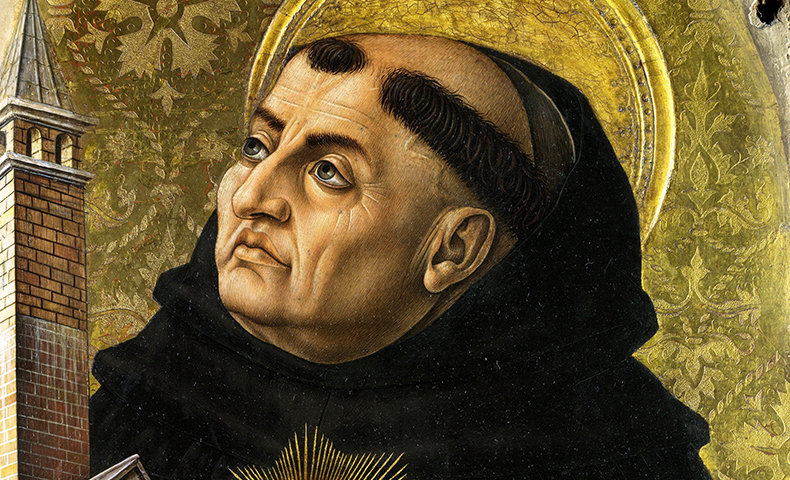
Thomas Aquinas, also known as the “Angelic Doctor”, was a 13th century Dominican priest, and one of the Catholic church’s most distinguished and recognizable philosopher and theologian.
Aquinas was born to a noble Italian family, and when he decided to follow the Will of God and join the Dominican Order, his family would not accept his decision, and locked him inside their family castle. It was only after petitioning and refusing to change his mind did his family finally relent and free him from his imprisonment.
Aquinas’s philosophy can be traced back to Aristotle. Aquinas even wrote numerous commentaries on the works of Aristotle, and Aquinas’s own philosophy has been described as ‘Aristotlian”.
Aquinas also believed that man was given knowledge and intellect and the understanding of truth by divine revelation by God, yet he did not believe that man was solely dependent upon divine revelation for these things. He believed that divine revelation was helpful and could occur when deemed appropriate by God, however he suggested that God gave man his intellect and ability to reason, and that that was sufficient enough for most men to understand truth and knowledge.
Aquinas wrote extensively on ethics as well. He most especially focused on virtue and how virtue is the perfection of a certain power, a way of acting. He went on to define 7 virtues. 4 he called cardinal virtues: temperance, fortitude, justice, and prudence, and 3 theological virtues: faith, hope, and charity.
The Angelic Doctor also touched upon political theory, claiming that man was made for community, and is a necessary part of their lives. He also went on to say that monarchy is the preferred method of government, as a monarch does not need to compromise. He made a distinction, however, when it came to the teachings of the Church, and said that in matters of doctrine and morality, the Church has authority over the monarchy, and that that relationship should be reflected.
Saint Thomas Aquinas had much more to say about all of this and then some, but to write about all of it would be to write a book or two. This article is meant merely to give a surface level look into what Aquinas wrote about and believed in terms of philosophy. This says nothing of course of his writings and beliefs on theology, a topic that he covers even more extensively.
 Philoso-raptor