

Who was he?
He was an important Enlightenment era Philosopher. For those that don’t know, the Enlightenment refers to a period when people began to challenge old assumptions. Does the Church need to run the state? Do invisible creatures cause things to move and fall? Should the masses govern themselves?
Fun fact: The enlightenment began 100 years before America’s 1776 revolutionary war. However, the enlightenment strongly influenced pre-war sentiment, and is credited with inspiring both America’s and France’s wars of independence.
What did he do?
He was largely responsible for spreading enlightenment ideals. Think of him as the enlightenments version of John the Baptist, spreading information that he thinks people need to hear.
He also wrote a vast amount of books. From plays to letters (basically essays), books, scientific works, histories, he did it all. Though many of them aren’t drooled over today (Not in the same way scholars drool over Shakespeare or Plato), they were still important works that helped to break mental chains.
Most scholars agree that his greatest work is Candide. It’s a satirical work in which the protagonist learns that blind optimism won’t solve his problems. It’s notable for a foolish professor character modeled after Gottfried Wilhelm Leibniz. Leibniz was a famous mathematician who espoused metaphysical (or fantastic) explanations for natural phenomena. Voltaire wasn’t a fan.
Why should I care?
Because he’s a very funny guy who isn’t afraid to speak his mind. Of all of the enlightenment Philosophers Voltaire would fit in the most in modern times. Read some of his quotes, and tell me you can’t see that as a tweet!
Aphorisms are short snappy observations that contain some general truth. Think of old timey sayings like “If it ain’t broke, don’t fix it.” I love dissecting these. Even if they don’t hold up upon closer examination, (if we never improve upon something, that thing will soon become outdated) it’s interesting to think about why that phrase became popular, why it sounds “right” on first glance, why it does apply to so many situations. Well as you can see in the next section, Voltaire has a ton of them. Aphorisms are Voltaire’s bread and butter!
I first became interested in Voltaire after hearing his views on fools. Upon further reflection, I realized that his views match up closely with The Bible’s view on fools. This is strange when you remember how vocal Voltaire was against the church (since he didn’t like authority).
Voltaire will warn that a fool is dangerous because he can persuade the masses to follow his foolishness.
Those who can make you believe absurdities, can make you commit atrocities.
– Voltaire.
The bible warns to avoid fools, lest you become foolish too.
Whoever walks with the wise becomes wise, but the companion of fools will suffer harm.
– Proverbs 13:20, ESV Bible.
This one got me.
It is difficult to free fools from the chains they revere.
-Voltaire
Now check this bible quote out:
Proverbs 26:4-5, ERV Bible.
There is no good way to answer fools when they say something stupid. If you answer them, then you, too, will look like a fool. If you don’t answer them, they will think they are smart.
And also
As a dog returneth to his vomit, so a fool returneth to his folly.
Proverbs 26:11, King James Bible.
Consider this: The Bible would call Voltaire a fool, because according to the bible “a fool says in his heart that there is no God.” Voltaire in return would dismiss the bible. Not because he’s an atheists, as often assumed. No, because he’s a diest, or someone who believes that, while God created the world, he does not interfere with how the world runs. While Voltaire believed in a god, he didn’t prescribe to a particular god.
But despite their differences in opinion, Voltaire and The Bible agree here. That tells me that, even if one or both of them are wrong, they stumbled upon a universal truth. That’s amazing.
Quotes
Click the images to expand.
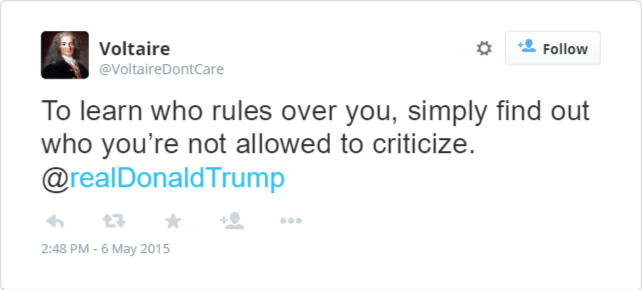
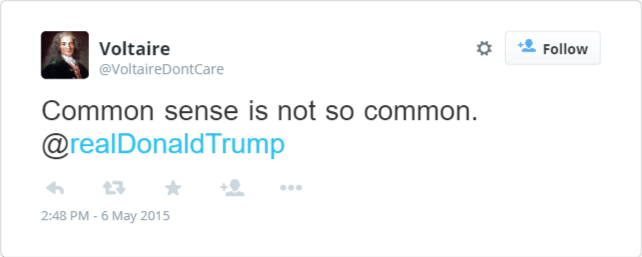
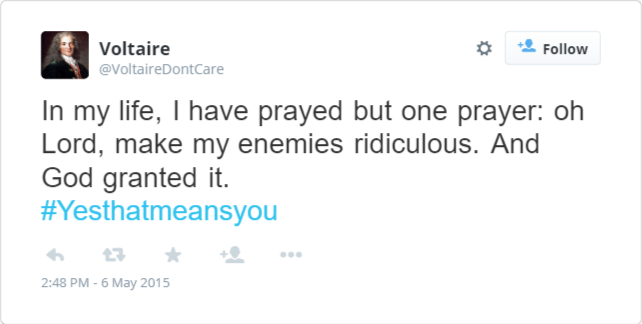
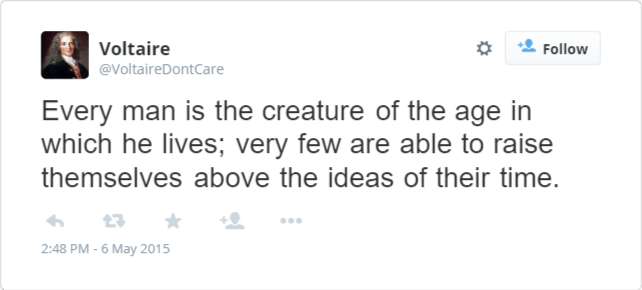
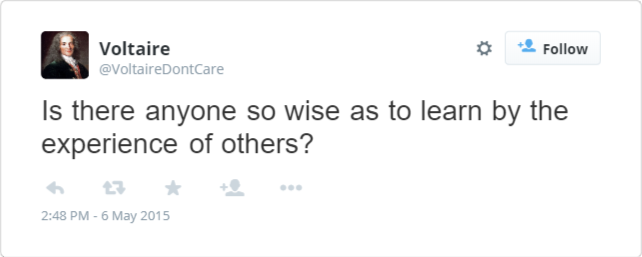
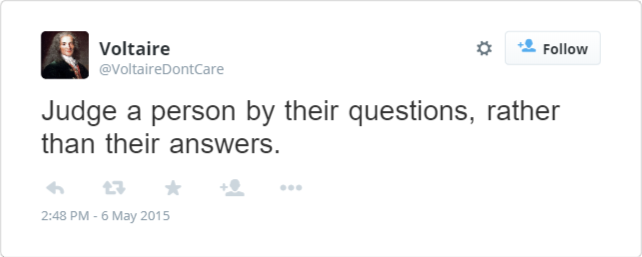
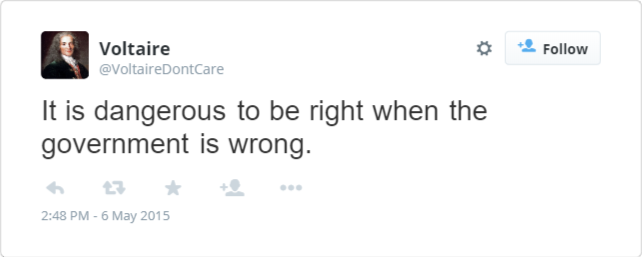
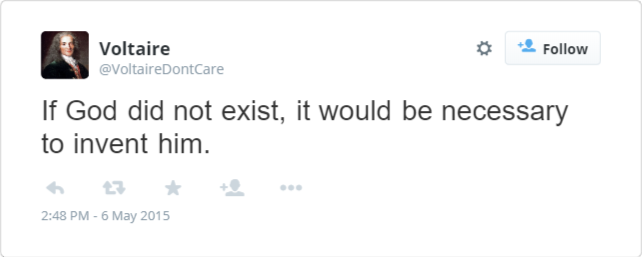
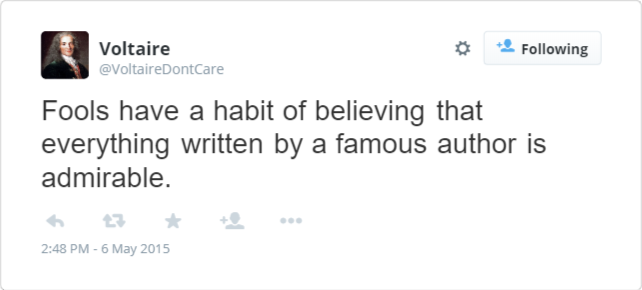
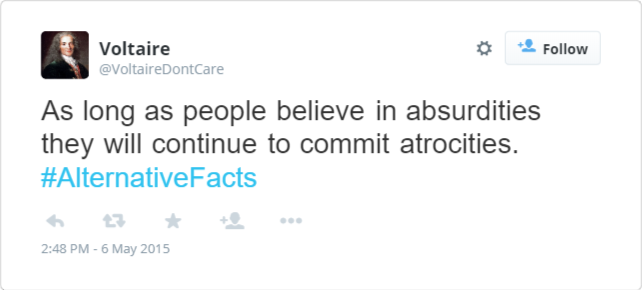
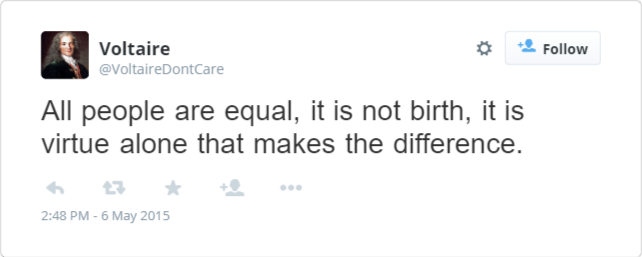
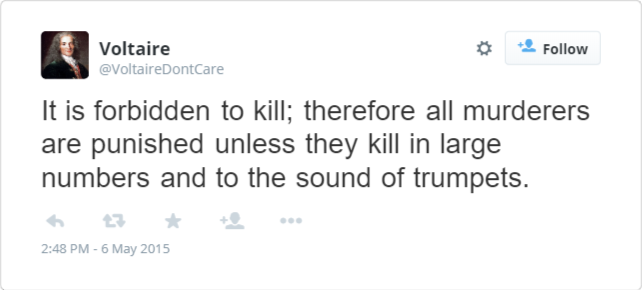
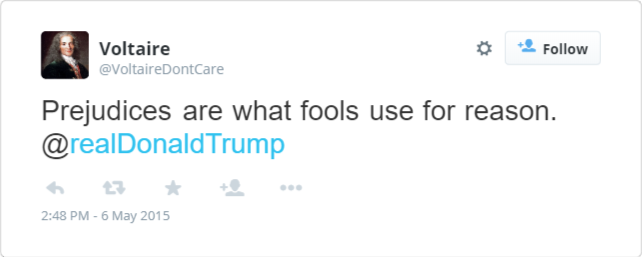
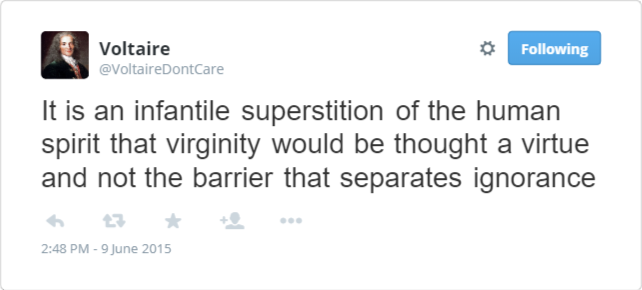
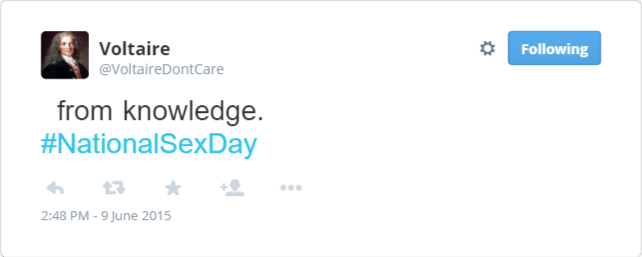
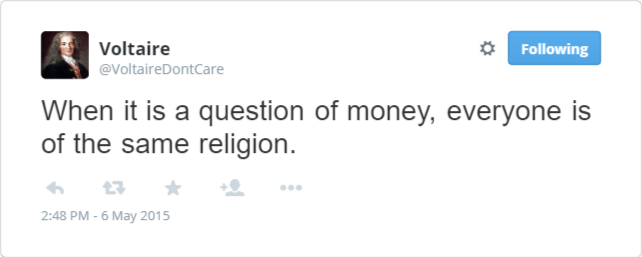

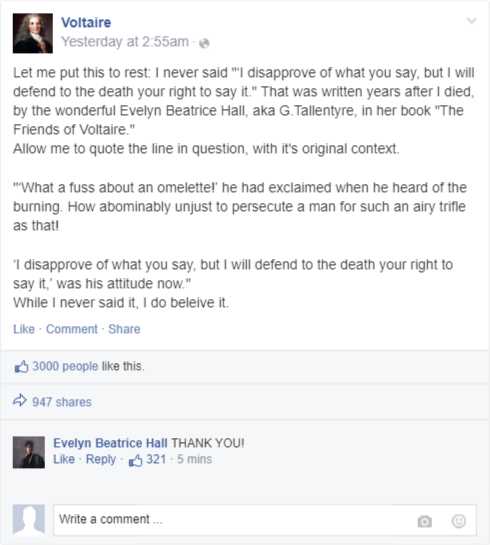
You may be wondering why I haven’t included Voltaire’s most famous quote. I’ll let the man himself explain.
Sources
https://plato.stanford.edu/entries/voltaire
Some readers singled out this part of the book as the major source of its controversy, and in a similar vein the very materialist account of “Âme,” or the soul, which appeared in volume 1 of Diderot and d’Alembert’s Encyclopédie, was also a flashpoint of controversy. Voltaire also defined his own understanding of the soul in similar terms in his own Dictionnaire philosophique. What these examples point to is Voltaire’s willingness, even eagerness, to publicly defend controversial views even when his own, more private and more considered writings often complicated the understanding that his more public and polemical writings insisted upon. In these cases, one often sees Voltaire defending less a carefully reasoned position on a complex philosophical problem than adopting a political position designed to assert his conviction that liberty of speech, no matter what the topic, is sacred and cannot be violated.
https://www.biography.com/people/voltaire-9520178
Voltaire, in keeping with other Enlightenment thinkers of the era, was a deist — not by faith, according to him, but rather by reason. He looked favorably on religious tolerance, even though he could be severely critical towards Christianity, Judaism and Islam.
As a vegetarian and an advocate of animal rights, however, Voltaire praised Hinduism, stating Hindus were “[a] peaceful and innocent people, equally incapable of hurting others or of defending themselves.”
https://www.philosophybasics.com/philosophers_voltaire.html
Voltaire was a prolific writer, and produced works in almost every literary form(plays, poetry, novels, essays, historical and scientific works, over 21,000 letters and over two thousand books and pamphlets). Many of his prose works and romances were written as polemics, and were often preceded by his caustic yet conversational prefaces.
https://www.britannica.com/biography/Voltaire
Voltaire believed above all in the efficacy of reason. He believed social progress could be achieved through reason and that no authority—religious or political or otherwise—should be immune to challenge by reason. He emphasized in his work the importance of tolerance, especially religious tolerance. In the Lettres philosophiques, Voltaire discussed the effects and benefits of religious tolerance.
https://www.theguardian.com/books/shortcuts/2015/jan/18/beginners-guide-voltaire-philosopher-free-speech-tolerance
Since the early 20th century, he has also been doomed to be misquoted by those using him as a weapon in the free-speech wars. He never actually wrote “I disagree with what you say, but I will defend to the death your right to say it” – this excellent formulation was, rather, the work of his English biographer, Evelyn Beatrice Hall (who also used a pseudonym: SG Tallentyre), who used it to describe his “attitude” in her 1906 biography, The Friends of Voltaire.
https://www.history.com/topics/british-history/enlightenment
There was no single, unified Enlightenment. Instead, it is possible to speak of the French Enlightenment, the Scottish Enlightenment and the English, German, Swiss or American Enlightenment. Individual Enlightenment thinkers often had very different approaches. Locke differed from Hume, Rousseau from Voltaire, Thomas Jefferson from Frederick the Great. Their differences and disagreements, though, emerged out of the common Enlightenment themes of rational questioning and belief in progress through dialogue.
https://quoteinvestigator.com/2015/06/01/defend-say/
Her book described an incident involving the French philosopher Claude-Adrien Helvétius who in 1758 published a controversial work titled “De l’esprit” (“On the Mind”). The book was condemned in the Parlement of Paris and by the Collège de Sorbonne. Voltaire was unimpressed with the text, but he considered the attacks unjustified. After Voltaire learned that the book by Helvétius had been publicly incinerated he reacted as follows according to Hall:
 Philoso-raptor
1 Comment