
Written by Jose Larosa.
Often, it can be easy to think that philosophy is some sort of time capsule, a field which, though it may have once had much to say, has long since stopped being relevant to the modern day and its attendant ills.
This is false! Many recent and contemporary philosophers are little known to the wider public, like Peter Singer, a utilitarian philosopher heavily associated with the animal rights movement, or Dr. Cornel West, a lifelong civil rights and economic equality advocate whose contributions to the field of racial sociology and thought are required reading at many academic institutions.
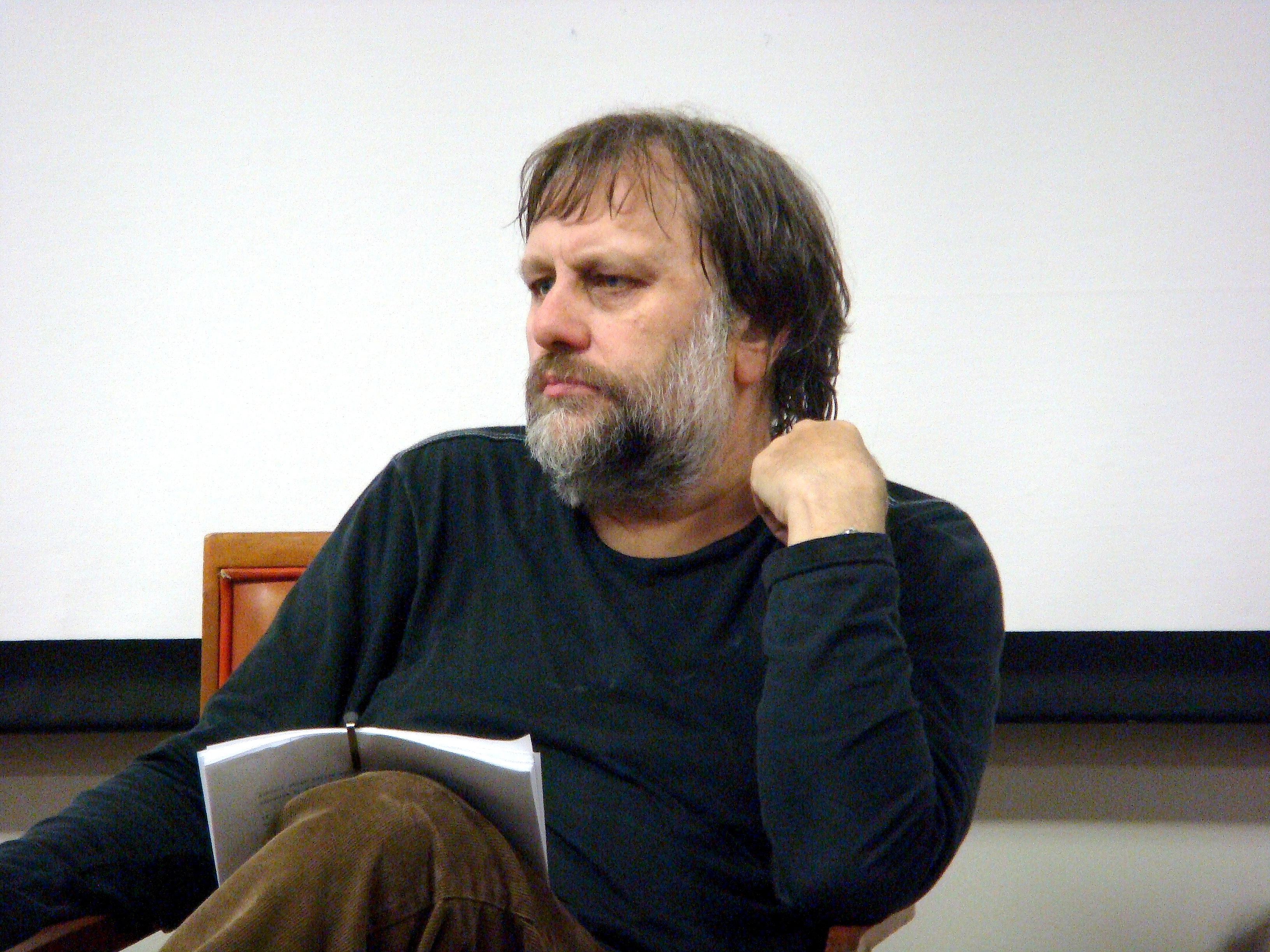
But the philosopher whom I’d like to focus on here is noted dissident and, according to some, “the most dangerous philosopher in the West,” Slavoj Zizek. A Slovenian who grew up during the early stages of the Cold War, he went on to experience not only state repression at the hands of Slovenia’s Soviet puppet regime, but also lived to see the fall of the Berlin wall, the dissolution of the Eastern Bloc, and the Balkan wars of the 90s which tore apart his native country of Yugoslavia into several independent nation states (Slovenia being his home state), resulted in mass casualties and inter-ethnic bloodshed, and left the region scarred in such a way that even today it has not recovered. Perhaps because of this, Zizek has a quality rare to philosophers of his stature: Slavoj will often engage in dark or absurd humor when writing or giving speeches, which he says became necessary ot only to make sense of the world’s atrocities, but also to engage younger and less-stuffy audiences.
Zizek’s contributions to psycho-analytic philosophy are many, but he is perhaps best known for his radical leftist critiques of modern capitalism and the society it breeds. Central to this critique is his emphasis on the ubiquity of “ideology.”
To fully understand what Zizek means by this, it helps to think of ideology not as representative of specific political philosophies, but instead as any story we tell ourselves which, in Zizek’s analysis, serves to comfort and blind us to real societal ills. Zizek points out that often times, ideology works even in spite of one’s refusal to believe in it.
To understand what is meant by this, Zizek offers plenty of examples in joke form. Take this apocryphal tale about the famous atomic scientist, Niels Bohr: the story goes that once, a fellow scientist friend was visiting Bohr, when, as he walked in under the door, he noticed a horseshoe hanging just above the frame; recognizing this as a popular superstition which was thought to ward off demons and ghosts, the friend immediately asked in disbelief why Bohr, a man of science and reason, would possibly believe such a thing. Bohr is said to have laughed and reassured his friend that no, he did not believe in the superstition. Bohr then says that the good news is that the horseshoe is supposed to bring good luck anyway, regardless of whether or not one believes in its ability to ward off ghosts and demons!
Whether or not this happened is impossible to verify, but it demonstrates not one, but two aspects of Zizek’s work on ideology. Firstly, even though Bohr clearly seems to agree that the superstition is silly, he nonetheless abides by it and allows himself to act accordingly. This is known as the “fake it until you make it!” school of thought, wherein you may not fully believe that something is true, but that, by acting as as if it were, you bring yourself closer to actually believing it.
Second, however, one should also notice Bohr’s friend, and how quick he is to categorize beliefs in two ways: the Objectively True, and the Objectively Not. However, Zizek points out that’ ideology is not necessarily the illusion masking the real, as many would like it to be, but instead that the real is itself *formed* by the subjective. Simply put, it’s not possible to rid ourselves of our biases, because every decision we make is based off of some sort of internal desire/bias (for example, the desire to avoid death is natural and can hardly be considered a prejudice which we would be better off discarding).
This is in fact the real kernel of Zizek’s thought: there can be no real objectivity, but this is not inherently a bad thing, because life itself is subjective, human life especially. Bohr’s friend is discounting Bohr’s belief, while at the same time refusing to recognize that his own set of beliefs (superstitions are dumb, one should believe only in hard scientific fact, etc) are subjective and incomplete, and the result of personal biases. Whether or not the ghosts or demons are real, or whether the horseshoe really works or not, is immaterial: it’s more about the fact that Bohr feels the need to hang the horseshoe up to begin with, the fact that it feels real to him.
Zizek also speaks often about how capitalist ideology has infected all areas of life. He frequently criticizes companies like Starbucks, which for a time liked to say that every cup of coffee bought would contribute money to protecting the rainforest, even though a) the actual money donated was a tiny and insignificant amount, and b) that Starbucks itself was causing environmental devastation, as well screwing over its own workers. Zizek knows that this ploy was nonetheless very effective, because people who would otherwise feel guilty about supporting Starbucks with their money can feel “absolved” by finding out that a small percentage is going to “save the rainforest,” thus quelling any anger either at themselves or Starbucks, temporarily.
 Philoso-raptor