
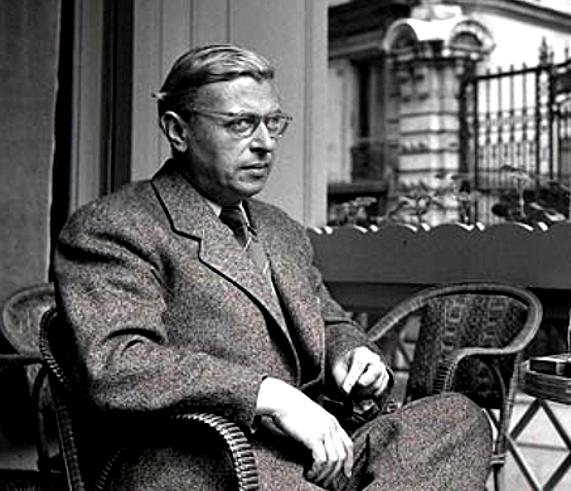
Note: my intention isn’t to make a post describing the philosophies of Jean-Paul Sartre or even to contemplate his upbringing and how it could’ve affected his ways of analyzing the world. I don’t want to resuscitate something that has died on a wikipedia page. I hope to simply write a creative essay of sorts, or an op-ed inspired by specific points in his philosophy that I’ve tried to apply in my life as a creative writer and the outcome(s) of such. End Disclaimer*
Written by Xylina Benjamin.
There are times when there seems to be a conflict of interest between logic and what takes place in my own mind, which is to say logic and I don’t always get along. Our relationship grew more strained once I watched a youtube video describing some ideas Satre shared during his lifetime. What stuck with me the most was his ideas concerning conformity. In the beginning, it made me view the world as a form of surrealism, where people and objects are assigned usage in a specific manner that almost everyone in specific geological locations agree on such usages.
That specific video analyzed our dinnertime meal, and how we decided to “eat at a specific time of day with our legs shoved under a piece of a dead tree and eat animals and foods that have been created by the earth,” to paraphrase. In theory, this makes sense to me. We adapt to routines and rituals and abide by them for the sake of tradition, seldom do we break tradition unless necessary.
What this means to me, is that I should rebel against tradition and the habits of us that seem to make us normal. Applying this practically, however, isn’t as easy. To not use a chair as its normal functionality, meaning if I chose to use it as a hat rather than a seat, I would look insane. I appreciate thinking of a chair as something other than a seat, though, which spurred me to apply this fight against conformity in a more creative and practical way.
I write creatively, short stories, poems, creative essays, and scripts. It is a fight to create something unique in these arts. What I’ve decided to do is incorporate a more direct form of Satre’s belief into a sort of absurdist fiction. To me, it can be funny or almost frightening to see a knife used as a toothpick or toilet water as face wash. It is an interesting way of experiencing non-conformity without personally suffering the consequences or humiliation of it. My characters are the ones doing these things and I can live it vicariously through them.
More personally, there are times when I’ve turned down opportunities in life because I fear conformity. I was studying journalism and even tried my hand at being an anchor for WCSU’s Election Connection during the midterm elections last fall. I have only good things to say about the experience in general and with the professor and other students.
My issue and the reason I’ve decided to stop studying journalism is because I felt I had to put on another personality, form a new dialect of sorts, wear my clothes and hair a specific way, and stand and move in predetermined manners. What matters most is the story, what’s interesting and newsworthy, and how can we decipher the truth… It wasn’t for me. I felt as though I had to become a different person in order to have a job.
While watching other news-anchors from NBC 30 News and WTNH, I felt that certain behaviors are standard and traditional and if one cannot conform to them, they don’t belong there. Personally, I need creative freedom and liberties to be different people in text but myself in person. I can’t let a job dictate how I carry myself and speak to the world.
And so, I further embraced Sartre’s ideologies, because it ultimately contributes to creativity and reveals who you really are in this world. Because as an existentialist,
“once [man is] thrown into the world, he is responsible for everything he does,”
– Sartre.
He is also responsible for what he does with the world and with what lens he chooses to see the world through.
 Philoso-raptor